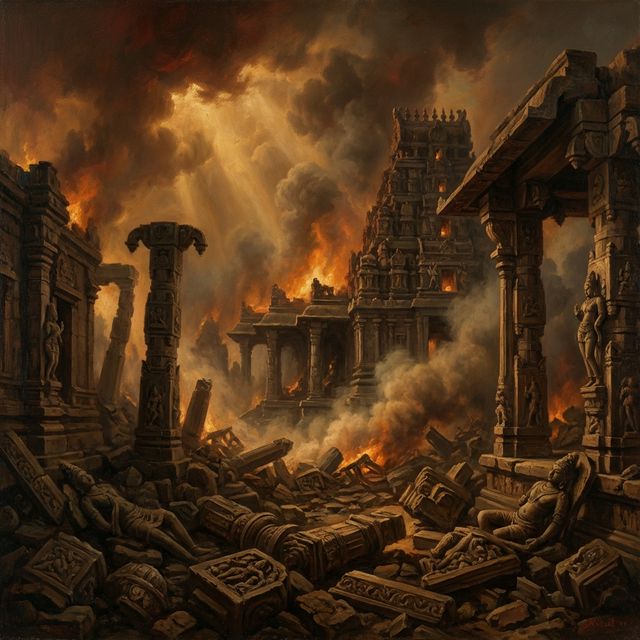
Dramatic depiction of ancient Indian Hindu temple in ruins — crumbling ornate stone pillars, fire and smoke rising, dark atmospheric sky with amber and crimson tones, representing the devastation wrought by Mahmud of Ghazni's raids on India's sacred heritage

Mahmud of Ghazni The Plunderer Who Ravaged India 17 Times

What your textbooks never taught you. A comprehensive, source-backed chronicle of the 17 devastating raids, temple destructions, mass plunder, and cultural annihilation inflicted by Sultan Mahmud of Ghazni (997–1030 CE) — and how India still bears its scars today.

Scroll to explore
📊 The Scale of Destruction

The Numbers They Don't Teach

Documented by medieval historians, archaeological surveys, and primary chronicles — the staggering scale of Mahmud of Ghazni's systematic plunder of India.

⚔️
0
Raids on India
997–1030 CE — documented by Al-Utbi & Al-Biruni
🏛️
0
Temples Destroyed or Looted
Per Tarikh-i-Yamini, Ferishta & archaeological records
💰
0
Estimated Loot (2024 Values)
Gold, jewels, and treasure extracted from India
🗺️
0
Major Cities & Temples Targeted
Somnath, Mathura, Kannauj, Thanesar, Nagarkot & more
🧭 Your Journey Through History

What This Encyclopedia Covers

Navigate through each chapter to uncover the layers of truth that have been systematically hidden, whitewashed, or overlooked in mainstream education.

📖
The sanitized textbook narrative vs. documented reality
Chapter 1

The Official Narrative

How Indian textbooks have portrayed Mahmud of Ghazni as a "great military commander" while systematically omitting his documented plunder and destruction. See the truth they hide.

Uncover the truth
📅
17 raids of documented destruction, year by year
Chapter 2

Timeline of 17 Raids

An interactive, chronological walk through every major raid during Mahmud of Ghazni's campaigns — from 997 CE to his death in 1030 CE.

Walk through time
🏛️
Somnath, Mathura, Thanesar — sacred sites ravaged
Chapter 3

The Raids Documented

Detailed accounts of specific raids — the destruction of Somnath, the sacking of Mathura, Kannauj, Thanesar, Nagarkot, and dozens more. With sources.

See the evidence
⛓️
Systematic religious oppression of Hindu communities
Chapter 4

Religious Persecution

Forced conversions. Mass enslavements. Idol-breaking as state policy. The execution of Brahmin priests. Jizya imposition. The full documented horror.

Read the accounts
🎭
Centuries of art, knowledge, and heritage — erased
Chapter 5

Cultural Destruction

Beyond temples — how Mahmud's raids destroyed libraries, universities, artistic traditions, sculptures, and centuries of accumulated knowledge and heritage.

Understand the loss
📊
Data visualization of the scale of plunder
Chapter 6

The Damage Quantified

Numbers, statistics, and data that put the scale of destruction into perspective — wealth looted, temples destroyed, populations enslaved.

See the numbers
🔗
How the past connects to India's present struggles
Chapter 7

Legacy & Modern Impact

How the destruction of that era echoes today — in the Somnath reconstruction, in lost economic wealth, and in the identity crisis of a civilization.

Connect past to present
📚
Complete bibliography of primary and secondary sources
Chapter 8

Sources & References

Every claim on this site is backed by primary sources — Tarikh-i-Yamini, Kitab-ul-Hind, Ferishta, ASI reports. Explore the complete bibliography.

Verify the sources
ℹ️
Our mission, methodology, and commitment to truth
About

About This Project

Why this website exists, our methodology for historical research, our commitment to accuracy, and how you can contribute to this educational initiative.

Learn more
The Sultan returned to Ghazni with so much booty, prisoners, and wealth that the fingers of those who counted them would have been tired. On his arrival, he ordered the court-yard to be spread with the jewels and unbored pearls and diamonds, rubies, emeralds and other precious stones. The ambassadors of foreign states stood amazed at the sight of such immense wealth. Tarikh-i-Yamini by Abu Nasr Muhammad al-Utbi (11th century CE), describing the aftermath of the raid on Somnath
Wikipedia: Mahmud of Ghazni
⚠️ Why This Matters Today

The Somnath Temple — destroyed by Mahmud of Ghazni in 1025 CE — was rebuilt multiple times and remains one of India's most sacred sites today. The very fact that it had to be rebuilt six times after repeated Islamic invasions is a testament to the resilience of Hindu civilization — and a reminder of the scale of destruction it endured. The current Somnath temple, rebuilt under Sardar Vallabhbhai Patel's initiative in 1951, stands as both a symbol of resistance and a living memorial to what was lost. Understanding this history is essential for every Indian.

🔍 Textbook vs. Reality

The Two Faces of Mahmud of Ghazni

One version lives in textbooks. The other is documented in primary historical sources written by medieval chroniclers — many of them court poets of Mahmud himself.

📗
What Textbooks Say
  • "A great military commander and empire builder"
  • "Patron of scholars like Al-Biruni and Firdausi"
  • "His raids were motivated by political and strategic reasons"
  • "Helped spread Islam peacefully in the subcontinent"
  • "Built the city of Ghazni into a magnificent capital"
  • "An important figure in the exchange of cultures"
📕
What History Documents
  • Raided India 17 times — solely for plunder and religious destruction
  • Destroyed the sacred Somnath Temple and personally smashed the Jyotirlinga
  • Looted wealth worth trillions in today's value from Indian temples
  • Enslaved hundreds of thousands of Hindus and sold them in Central Asian markets
  • Destroyed temples at Mathura, Thanesar, Kannauj, Nagarkot and dozens more
  • Used plundered Indian wealth to build Ghazni — India bore the cost of his "magnificence"
  • Adopted the title "Yamin ud-Dawlah" — Right Hand of the State — for his jihad
  • His court historian Al-Utbi recorded temple destructions as achievements, not crimes
🕯️ Education is the First Step

History Forgotten is History Repeated

This website exists because every Indian has the right to know their true history. Every claim is backed by primary historical sources. Every fact is verifiable. Begin your journey through the chapters that textbooks left out.