Chapter 4
Religious Persecution
Forced conversions. Mass enslavement. Idol-breaking as state policy. The documented systematic persecution of Hindu communities.
Forced conversions. Mass enslavement. Idol-breaking as state policy. The documented systematic persecution of Hindu communities.
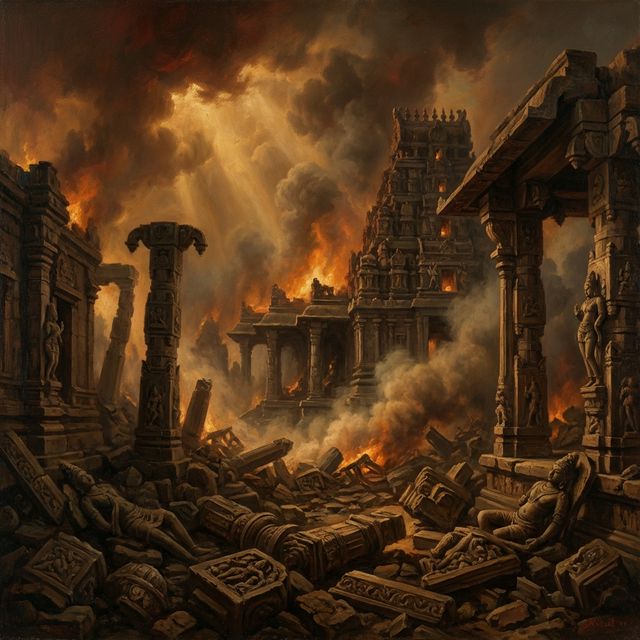
Mahmud of Ghazni's destruction of Hindu temples was not incidental to his military campaigns — it was a central objective. His own court historians documented temple destruction not as collateral damage but as religious duty and pious achievement.
Al-Utbi, Mahmud's court historian, consistently framed the destruction of Hindu temples as acts of devotion to Islam. When Mahmud smashed the Somnath Jyotirlinga, Al-Utbi recorded it as the fulfillment of the sultan's role as a ghazi — a warrior of the faith.
The Abbasid Caliph formally recognized Mahmud's raids as jihad and bestowed upon him honorific titles. This was not medieval raiding for profit alone — it was ideologically sanctioned religious warfare against Hindu civilization.
One of the most devastating — and least discussed — aspects of Mahmud's raids was the systematic enslavement of Hindu populations. After every major campaign, thousands of Indian men, women, and children were captured and marched to Central Asia to be sold in slave markets.
The slave markets of Ghazni, Balkh, and Nishapur were flooded with Indian captives. The price of Indian slaves became so low that they were sold for a few dirhams each. This mass enslavement represents one of the largest forced population transfers in medieval history.
Multiple primary sources document that populations in conquered territories were given the choice of conversion to Islam or death. This was not a passive cultural influence but systematic religious coercion backed by military force.
The demographic impact of these forced conversions, combined with mass enslavement and population displacement, permanently altered the religious composition of northwestern India — a change that persists to this day.
Mahmud's treatment of Hindu religious symbols went beyond mere destruction — it involved deliberate humiliation. The pattern was consistent across multiple raids:
These were not the actions of a "great military commander" engaged in medieval warfare. They were systematic acts of civilizational humiliation — designed to break the spirit of Hindu communities and demonstrate the supremacy of the invading faith.
It is critical to understand that Mahmud's raids were not purely economic — they were framed, legitimized, and celebrated within an explicit jihad framework.
This framework is important because textbooks typically present the raids as "politically motivated" — stripping the explicitly religious nature of the campaigns and their documentation.