Chapter 5
Cultural Destruction
Beyond temples — the devastation of India's knowledge systems, artistic heritage, libraries, universities, and centuries of accumulated civilization.
Beyond temples — the devastation of India's knowledge systems, artistic heritage, libraries, universities, and centuries of accumulated civilization.
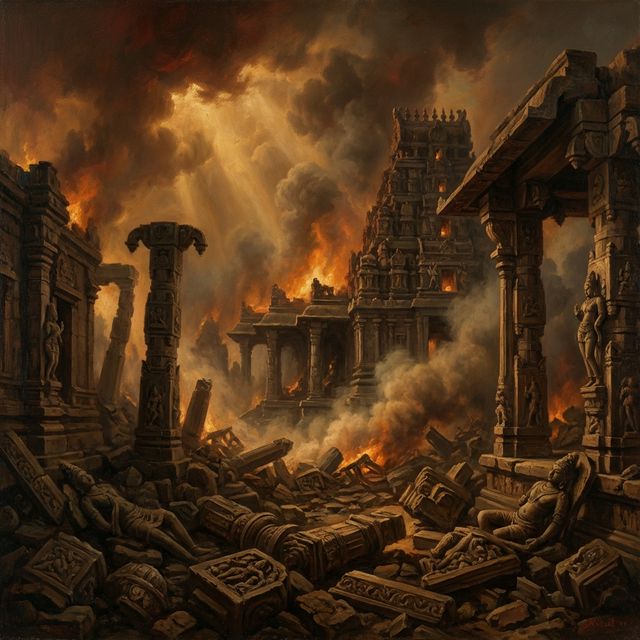
Hindu temples in medieval India were not merely places of worship — they were comprehensive institutions of learning, art, and culture. Every major temple complex functioned as a university, library, astronomical observatory, medical school, and centre for the performing arts. When Mahmud destroyed a temple, he destroyed an entire ecosystem of knowledge.
The most powerful testimony to the cultural devastation comes paradoxically from Al-Biruni — the very scholar whom textbooks celebrate as Mahmud's "court intellectual." In his Kitab-ul-Hind (c. 1030 CE), Al-Biruni documented the sophistication of Hindu learning systems — and lamented their destruction:
Al-Biruni recognized that Mahmud's raids had done irreparable damage to Indian knowledge systems. He noted that Hindu scholars had fled from conquered territories, taking their manuscripts and learning with them — but not all could be saved.
In his study of Indian civilization, Al-Biruni documented knowledge systems of extraordinary sophistication — mathematics, astronomy, philosophy, medicine — that were being systematically destroyed by the very ruler who employed him. His Kitab-ul-Hind is simultaneously a tribute to Indian civilization and an inadvertent autopsy report on its destruction.
The temples destroyed by Mahmud contained some of the finest examples of Indian sculpture, bronze-casting, wood-carving, and architectural achievement. When Al-Utbi records that Mahmud marveled at Mathura's temples saying they could not be rebuilt in 200 years — before ordering them destroyed — he is documenting the deliberate annihilation of artistic masterpieces.
The economic impact of Mahmud's raids extended far beyond the immediate plunder. Temples were economic institutions — they managed agricultural estates, supported artisan communities, facilitated trade, and maintained irrigation systems. Their destruction caused cascading economic collapse:
The supreme irony of Mahmud of Ghazni's legacy is this: textbooks celebrate him as a "patron of learning" because he employed scholars like Al-Biruni and the poet Firdausi. But the culture he used to fund that "patronage" — the wealth, the artistic traditions, the knowledge systems — was stolen from Indian civilization.
Al-Biruni's Kitab-ul-Hind is considered a masterpiece of medieval scholarship. But it was funded by the plunder of the very civilization he was studying. Firdausi's Shahnameh was written largely at Mahmud's court — paid for with Indian temple gold.
India's wealth funded its own civilizational impoverishment. This is the reality that textbooks refuse to acknowledge.