Chapter 7
Legacy & Modern Impact
How the destruction of Mahmud's era echoes in India's present — in the Somnath reconstruction, economic trajectory, and education system.
How the destruction of Mahmud's era echoes in India's present — in the Somnath reconstruction, economic trajectory, and education system.
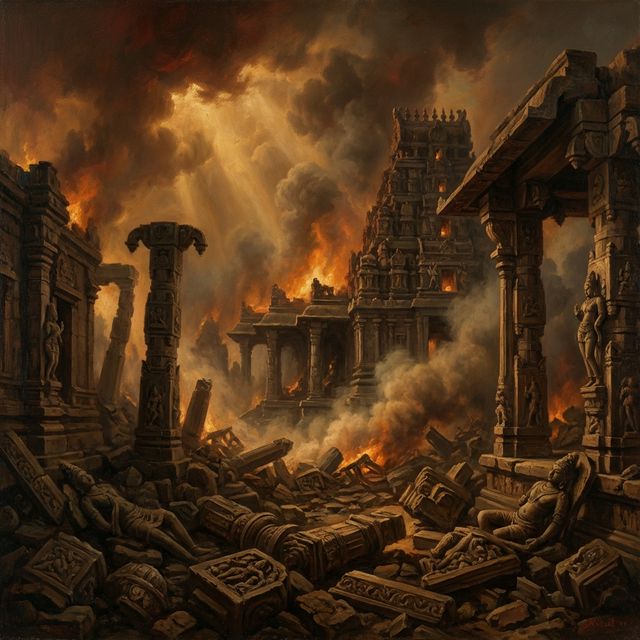
The Somnath Temple stands as perhaps the most powerful symbol of the legacy of Mahmud of Ghazni's raids — and of India's response to them. The temple was destroyed and rebuilt six times:
The fact that Hindus rebuilt Somnath six times — each time after devastating destruction — is a testament to civilizational resilience. But it is also evidence of the unrelenting nature of the destruction that the temple endured.
Perhaps the most devastating legacy of Mahmud of Ghazni's raids is that they established the template that every subsequent invader of India would follow for the next seven centuries:
Mahmud proved that India's temple wealth was accessible, its kingdoms disunited and vulnerable, and that raids could be conducted with impunity. Every invader after him exploited this template.
Perhaps the most insidious legacy of this era is how it is taught — or not taught — in Indian schools today.
This educational gap is not accidental. As documented by Arun Shourie in Eminent Historians, the systematic minimization of Islamic-era atrocities in Indian textbooks was a deliberate policy choice made during the post-independence period — driven by a misguided belief that hiding uncomfortable truths would promote communal harmony.
A civilization that does not know its own history cannot understand its present. When Indians don't know why Somnath was rebuilt six times, why certain temple sites are contested, or why India's economic share of the world declined — they cannot make informed judgments about their own heritage, their own identity, or their own future. This is the real cost of the whitewashed textbook.
Understanding Mahmud of Ghazni's legacy is not about fostering resentment — it is about building historical literacy so that Indians can be informed citizens.
History remembered is history that teaches. History forgotten is history repeated.